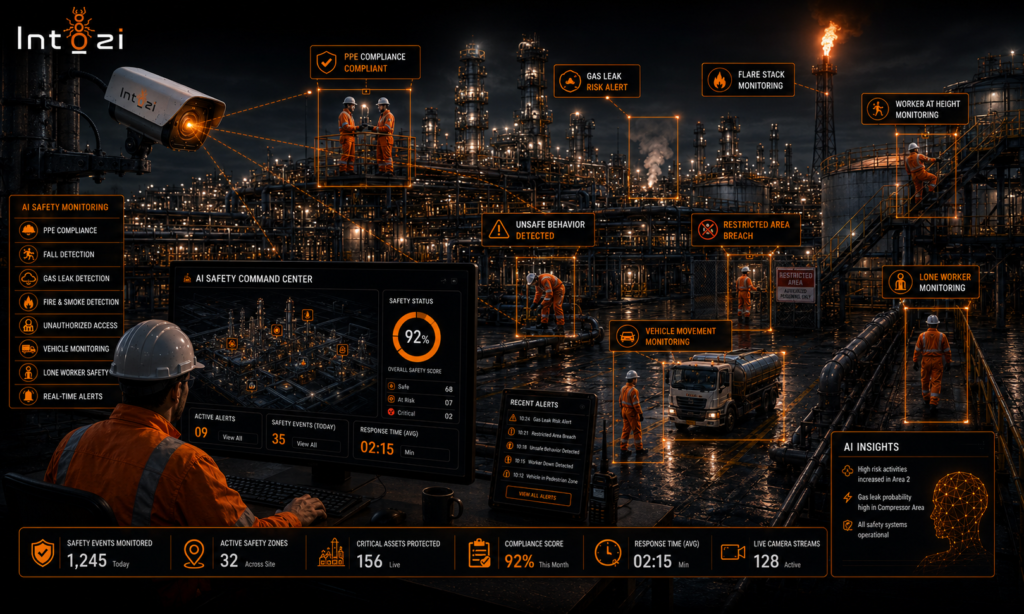
In oil and gas plants, a single undetected leak or spark can turn into a catastrophe within minutes, which is why AI gas leak detection system technology now works to catch danger at its earliest visible stage. By analyzing live camera feeds in real time, AI spots the subtle signs of escaping gas, smoke, and flame the moment they appear, alerting teams long before conditions escalate beyond control.
How Does AI Detect Gas Leaks from Video?
Modern AI fire hazard detection for oil and gas relies on computer vision trained to recognize the visual and thermal signatures that accompany leaks and combustion. Using optical and infrared camera inputs, it detects the distortion, vapour clouds, and heat patterns that signal escaping hydrocarbons, confirming a hazard only when multiple indicators align rather than reacting to a single ambiguous frame.
The detection process typically evaluates:
- Vapour and gas plumes through optical-flow and infrared analysis
- Flame signatures including colour spectrum, flicker, and growth rate
- Smoke behaviour such as diffusion, opacity, and upward drift
- Thermal anomalies that reveal overheating equipment before ignition
Why Is Early Detection So Critical in Oil and Gas?
The value of early hazard detection using AI lies in the seconds and minutes it buys response teams. Traditional point sensors only react once gas or heat physically reaches them, but in sprawling refineries and pipeline corridors, that delay can be fatal. AI sees the hazard at its source the instant it becomes visible, regardless of where it occurs across a vast facility.
This head start lets operators isolate valves, shut down units, and evacuate zones while an incident is still small and contained, directly reducing the risk of explosions, environmental damage, and loss of life.
How Does Ikshana Power Real-Time Hazard Detection?
Ikshana, Intozi’s video analytics platform, is the engine behind this capability. It processes multiple camera streams simultaneously at the edge, running gas, smoke, and fire detection in real time without overloading central infrastructure. By unifying detection, alerting, and verification within a single platform, Ikshana delivers instant, accurate warnings across an entire plant from one consolidated view, ensuring no high-risk zone goes unmonitored.
This unified approach also simplifies operations for safety teams. Instead of juggling separate tools for different units, operators monitor every camera, alert, and verification step in one place, which speeds up response and removes the blind spots that fragmented systems leave behind.
How Does AI Reduce False Hazard Alarms?
Oil and gas environments are full of triggers that fool conventional systems, steam, flares, exhaust plumes, dust, and heat haze. A reliable oil and gas safety monitoring system built on AI cuts false alarms by validating multiple visual and thermal indicators together before raising an alert, distinguishing genuine hazards from harmless lookalikes. This multi-factor confirmation keeps operations running while ensuring real threats are never missed.
Intozi strengthens reliability through:
- Multi-cue verification that confirms gas, smoke, and flame signatures jointly
- Environment-aware tuning adapted to flares, steam, and heat haze
- Persistence checks that filter transient visual noise
- Human-in-the-loop review for rapid validation of edge cases
Fewer false alarms matter for more than convenience. Repeated nuisance alerts erode team trust and slow response, so keeping false positives low is essential to ensuring every genuine warning gets the urgent attention it demands.
Why Is Intozi Built for Oil and Gas Conditions?
Detection accuracy depends on the environment it operates in, and Intozi designs its systems specifically for demanding oil and gas sites. AI video analytics for oil and gas industry must perform reliably across refineries, storage terminals, and pipeline networks where scale, weather, and constant thermal activity challenge ordinary detectors. Intozi’s deep domain experience ensures detection stays precise where generic systems falter, protecting assets, operations, and people without constant false-alarm disruption.
This industrial focus extends to integration as well. Intozi’s systems are designed to work with existing camera infrastructure and control-room workflows, so plants gain advanced hazard detection without costly rip-and-replace projects or disruptive downtime during deployment.
Faster Detection, Safer Plants
AI hazard detection works by turning existing cameras into an always-on early-warning network that sees danger the moment it appears. By combining real-time video and thermal analysis, multi-cue verification, and reliable performance in harsh conditions, Intozi helps oil and gas plants detect leaks and fires earlier, respond faster, and prevent small incidents from becoming catastrophic losses. For any operation where safety, downtime, and environmental risk are at stake, that early warning is the most valuable safeguard a facility can deploy.
Frequently Asked Questions (FAQs)
How does AI detect a gas leak before traditional sensors?
AI analyzes live optical and infrared camera feeds for vapour clouds, thermal anomalies, and flame signatures at their source, alerting teams the instant a hazard becomes visible rather than waiting for gas or heat to reach a fixed sensor.
Can AI hazard detection work around flares and steam?
Yes, it validates multiple visual and thermal indicators together and uses environment-aware tuning, so it distinguishes real leaks and fires from flares, steam, and heat haze while keeping false alarms low.
Does AI safety monitoring need special cameras?
It often works with existing CCTV and can use infrared or optical gas-imaging cameras for leaks, analyzing their feeds in real time, which makes deployment faster and more cost-effective than full hardware replacement.
How accurate is AI-based hazard detection in oil and gas plants?
Accuracy is high because the system confirms hazards through several combined cues and persistence checks, reducing both missed events and false alarms across complex, large-scale facilities.
Can one system monitor an entire refinery or pipeline network?
Yes, platforms like Ikshana process many camera streams simultaneously and consolidate alerts into a single dashboard, letting teams oversee multiple units, terminals, or pipeline segments from one central view.